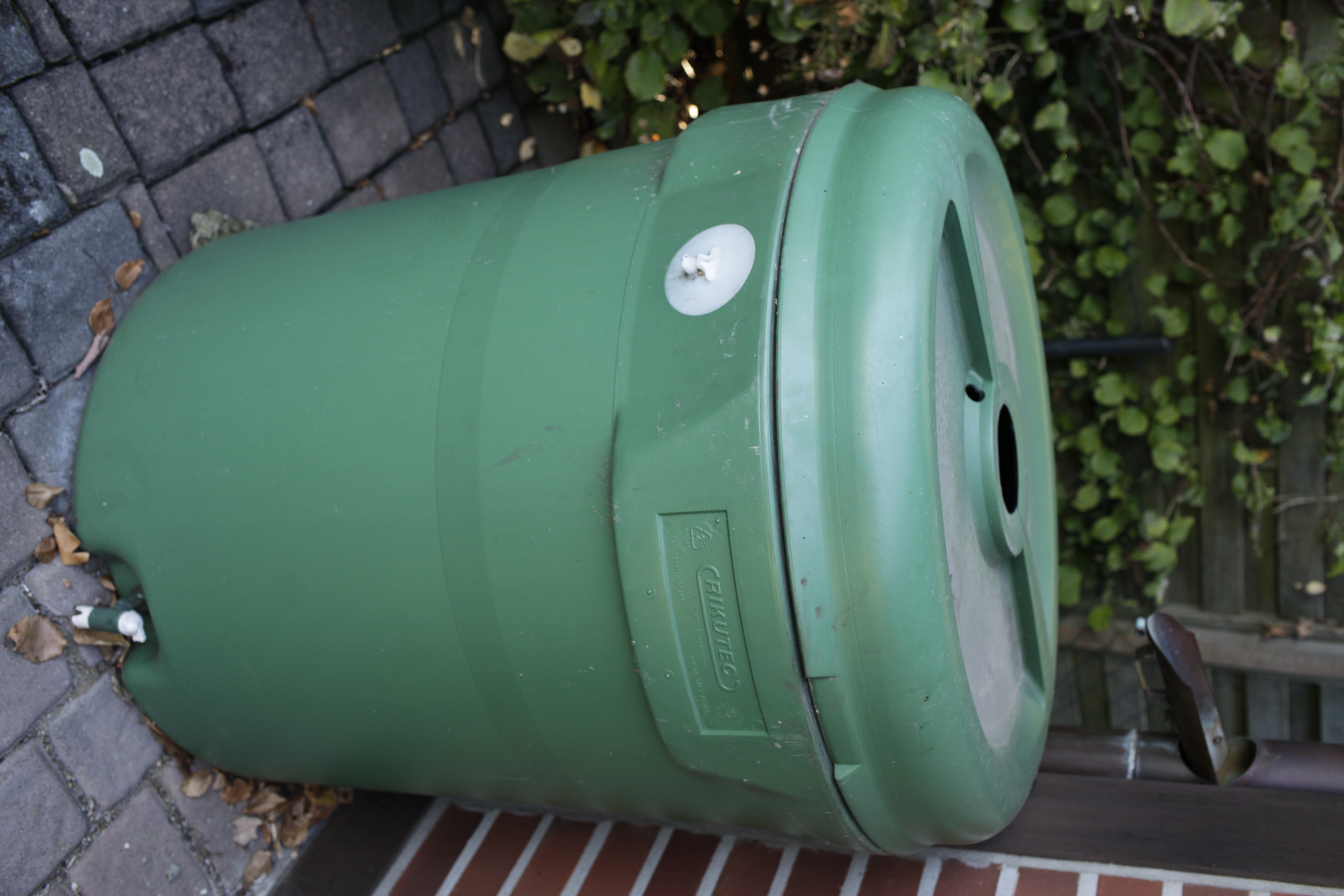
A 200-litre rainwater tank. Wikimedia Commons / Jeuwre, CC BY-SA 4.0
The most common mistake when buying a rain barrel is treating it as a single-size purchase. A 200-litre barrel placed under a downspout serving a large section of roof will overflow in a moderate rain event and spend most dry periods empty. Getting the volume right requires knowing three numbers: the roof area draining to that downspout, the typical storm depth for your region, and the conversion factor that links the two.
The basic catchment formula
The volume of water a roof sheds during a storm is calculated with a straightforward formula:
Where:
- V = volume of runoff in litres
- A = horizontal roof area draining to the downspout, in square metres
- R = rainfall depth in millimetres
- C = runoff coefficient (dimensionless)
The conversion from millimetres and square metres to litres introduces a factor of 1.0 (since 1 mm of rain on 1 m² produces exactly 1 litre). The runoff coefficient for a standard asphalt shingle roof typically falls between 0.85 and 0.95. A value of 0.90 is commonly used in residential estimates, accounting for minor losses to evaporation and surface absorption.
A roof area of 50 m² during a 20 mm rainfall event produces approximately 50 × 20 × 0.90 = 900 litres of runoff if the entire area drains to a single downspout. A standard 200-litre barrel would fill four times over.
Measuring your roof drainage area
The relevant measurement is the horizontal projection of the roof section that drains to a specific downspout — not the slope length of the roof surface. On a typical detached house in Canada, a single downspout may serve anywhere from 20 m² to over 80 m² of horizontal roof area, depending on roof design and gutter layout.
How to estimate it
The simplest approach is to measure the footprint of your house and divide it by the number of downspouts, assuming roughly equal drainage areas. For a more precise figure, trace the ridge and valley lines on the roof and determine which sections slope toward each gutter run. Municipal programs in Toronto and Vancouver use the same horizontal projection method in their rain barrel sizing guidance.
Finding rainfall data for your area
Environment and Climate Change Canada publishes historical precipitation data through the Canadian Climate Data portal. For barrel sizing, the most useful figure is the typical 24-hour rainfall depth for a storm of moderate return period — often the 2-year or 5-year return storm — at your nearest weather station.
| Region | Typical summer storm (mm) | Notes |
|---|---|---|
| Vancouver, BC | 25–40 | Frequent low-intensity events; high annual total |
| Toronto, ON | 20–35 | Convective summer storms; irregular distribution |
| Calgary, AB | 15–30 | Drier continental climate; intense localized events |
| Halifax, NS | 20–40 | Coastal exposure; remnant storm systems common |
| Winnipeg, MB | 15–25 | Prairie semi-arid; summer thunderstorm-driven |
Figures derived from ECCC historical station records. Verify current data at climate.weather.gc.ca.
Matching barrel size to runoff volume
The goal of sizing is not to capture every drop from the largest possible storm — that would require impractical volumes. Instead, the aim is to capture a useful portion of the typical mid-season storm before the barrel fills and overflow begins.
A commonly cited rule in municipal programs is to size the barrel to capture approximately 25 mm of rainfall from the contributing roof area. This represents a moderate event that occurs several times per growing season in most Canadian regions.
| Roof area (m²) | Target capture (25 mm storm) | Suggested minimum barrel (litres) |
|---|---|---|
| 20 | 450 L | 200 L (partial capture) |
| 40 | 900 L | 400–500 L |
| 60 | 1 350 L | 600–800 L |
| 80 | 1 800 L | 800–1 000 L or multiple barrels in series |
Multiple barrels in series
When a single large barrel is impractical, two or more standard 200-litre barrels can be connected in series using a linking hose at the base. Water fills the first barrel and overflows through the link into the second. This arrangement uses standard hardware and keeps individual units manageable for winter removal.
Runoff coefficients by roof material
Not all roofing materials shed water at the same rate. Metal roofing approaches a coefficient of 0.95 because nearly all rainfall runs off immediately. Cedar shakes absorb more water initially, particularly at the start of a storm, resulting in a lower effective coefficient of 0.70–0.80. Asphalt shingles, which cover the majority of Canadian residential construction, fall in the 0.85–0.95 range depending on age and condition.
References
- Environment and Climate Change Canada — Canadian Climate Data
- City of Toronto — Rain Barrel Program
- Toronto and Region Conservation Authority